My project 2b, goal and purpose is to teach students the chemical bonds between atoms in molecules such as H2, CH4, NH3, H2 CCH2, N2, Cl2 and many large biological molecules are covalent. A
covalent bond is a chemical bond that is the sharing of pairs of electrons between atoms. It is also described as attraction to repulsion stability between atoms when they share electrons. The covalent bonds between atoms is occur when one atom needs to borrow from another in order to have a full valence shell. The full valence shell allows atoms to be stable. When it is unstable, many unfortunate things may occur. To watch a video of a covalent bond, click
here.
Examples:
H2:

This bond shows two hydrogen atoms forming a covalent bond because they both contain 1 electron. They both need 2 electron in order to form a full valence shell.
CH4:

This lewis dot structure shows four 1 atom hydrogens and one carbon atom containing four electrons which also need to become stable. These 5 atoms make each other stable.
NH3:

NH3 shows two electrons on top that are already paired the remaining 3 electrons on the nitrogen atom.
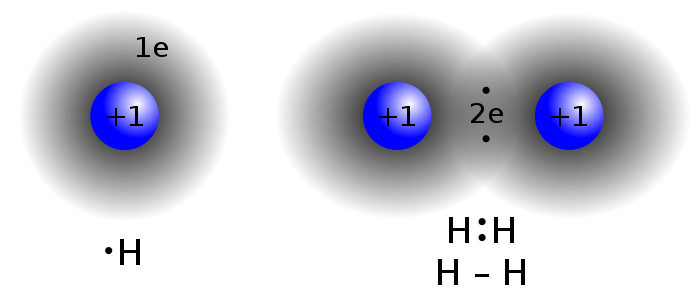 This bond shows two hydrogen atoms forming a covalent bond because they both contain 1 electron. They both need 2 electron in order to form a full valence shell.
 This lewis dot structure shows four 1 atom hydrogens and one carbon atom containing four electrons which also need to become stable. These 5 atoms make each other stable.
 NH3 shows two electrons on top that are already paired the remaining 3 electrons on the nitrogen atom.


No comments:
Post a Comment